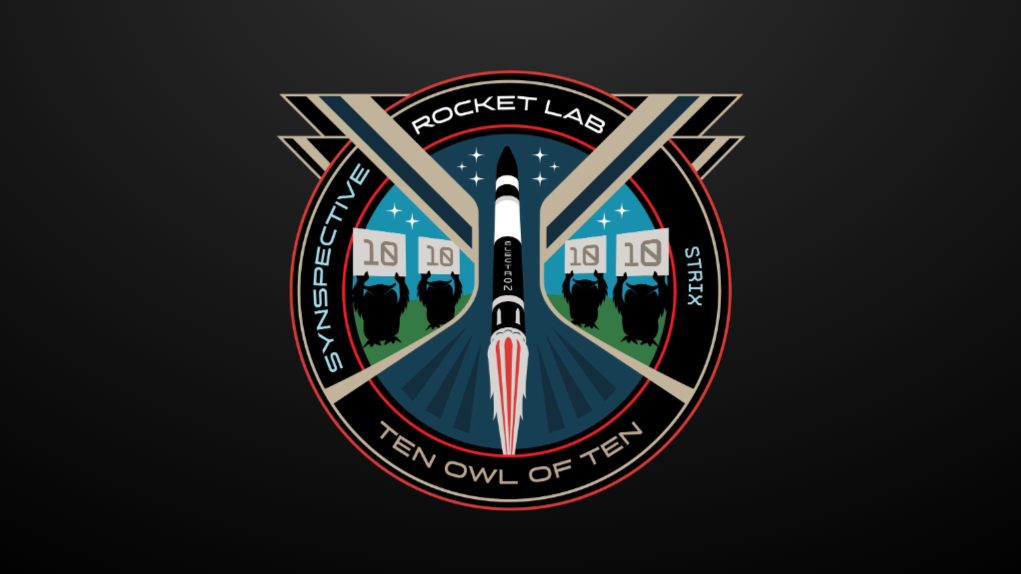
Rocket Lab launched the "Ten Owl of Ten" mission from New Zealand today (June 26), adding to Japanese company Synspective's imaging constellation.
An Electron rocket lifted off from Rocket Lab's Launch Complex-1 (LC-1) in New Zealand today (June 26) at 1:43 p.m. EDT (1743 GMT; 5:43 a.m. on June 27 local New Zealand time).
As its name suggests, the "Ten Owl of Ten" mission sent up Synspective's 10th synthetic aperture radar (SAR) satellite, which will expand the company's network above Japan to provide imaging data for use in city planning, monitoring infrastructure and responding to natural disasters.
The launch was Rocket Lab's 12th so far in 2026, and the ninth for Electron this year (the other flights were performed by the HASTE rocket, a suborbital variant of Electron). Electron, Rocket Lab's workhorse small-lift launch vehicle, stands 59 feet (18 meters) tall and can launch payloads weighing up to 661 pounds (300 kilograms) to low Earth orbit (LEO).
Synspective has booked Electron to launch the entirety of its Strix constellation, with 17 more on the rocket's manifest expected to launch before 2030. The satellites are named after a genus of owls, drawing inspiration from the birds' visual acuity.
Like their namesake, the Strix satellites' SAR antennas allow the spacecraft to collect Earth-observation data in every lighting condition (and also through cloud cover, which the birds can't quite match).
Each Strix satellite weighs about 220 pounds (100 kg), and stretches to 16.4 feet (5 meters) wide with its SAR antenna fully deployed. Each satellite has an on-orbit lifespan of about five years, according to Synspective's website. The spacecraft cruise in LEO between 15 and45 degrees of inclination.
If all goes according to plan, Electron will deliver the "Ten Owl of Ten" Strix to an inclination of 42 degrees, at a LEO altitude of 343 miles (552 kilometers).
Electron's second stage will separate about 2 minutes, 40 seconds after liftoff today, with the third or "kick" stage taking over about nine minutes into flight. Payload separation is expected about 45 minutes later, around T+1 hour after liftoff.
Editor's note: This story was updated at 1:50 p.m. ET on June 26 with news of successful liftoff.